Decision Fatigue: Why Small Choices Can Feel So Exhausting
What should I wear? Should I answer that email now? Which task comes first? Do I need to book the appointment today? What are we having for dinner? Should I say yes to this meeting? Which of the seventeen almost identical options am I supposed to choose? None of these decisions is particularly dramatic on its own, but by the end of the day even choosing what to watch can suddenly feel like an unreasonable amount of work. You open Netflix, scroll for ten minutes and eventually decide you would rather watch nothing at all.
This is often described as decision fatigue: the idea that repeatedly making choices can add to our mental load and make later decisions feel more effortful. It is an appealing explanation for that familiar end-of-day feeling when the smallest choice somehow seems to require a board meeting. The science is more nuanced than the phrase sometimes suggests, but the experience of cognitive overload is very real.
Your Brain Makes More Decisions Than You Notice
We tend to think of decisions as big moments: taking a new job, moving house, making an important purchase. But most of the decisions we make are far less memorable. They happen almost automatically, scattered throughout the day between messages, meetings, errands and responsibilities. Do I reply now or later? Do I finish this first or start that? Do I accept the invitation? What should I eat? Should I order it, cook it or skip it because I am already late?
The difficulty is not necessarily that any one choice is hard. It is that modern life can require us to keep evaluating, prioritising and switching context almost continuously. By the time an actually important decision arrives, it may be competing with a day already full of smaller demands. Research on decision fatigue suggests that cognitive load, time pressure and repeated decision-making can influence how effortful later choices feel, although researchers are still studying exactly how strong and consistent these effects are.
Small Decisions Can Create a Surprisingly Big Mental Load
A choice requires more than simply choosing. You have to notice the options, compare them, predict possible outcomes and decide which information deserves attention. Sometimes you also need to remember what you decided earlier so that the next decision makes sense. Do that once and it is nothing remarkable. Do it repeatedly while answering messages, shifting between tasks and managing everything else in your life, and the mental landscape begins to look very different.
This is why a day filled with apparently “small” things can leave you surprisingly drained. Mental effort is still effort, even when nobody can see it. A full day of tiny choices, interruptions and constant prioritising can create the sense that your brain has been working continuously, even when there was no single enormous task.
Too Many Options Are Not Always a Luxury
Having options is usually a good thing, until you are standing in front of thirty versions of the same product wondering why toothpaste has become a research project. Modern life offers an extraordinary number of choices. There are hundreds of shows to watch, thousands of products to buy, endless restaurant menus, twenty ways to organise your calendar and an entire internet waiting to tell you that you have selected the wrong moisturiser.
More choice can be useful, but more choice also means more information to evaluate. This is especially noticeable when the differences between options are small. When one answer is clearly better, the decision may be easy. When five options all look approximately right, we can spend far more energy trying to identify the theoretically perfect one. Sometimes what looks like indecisiveness is simply a brain being asked to compare too much information at once.
Decision Fatigue Is Not the Same as Being Bad at Decisions
There is an important difference between struggling with a decision and being incapable of making good ones. Context matters. A choice that feels obvious in the morning may feel much harder after hours of concentrated work, and a decision that seems manageable on a quiet Sunday might feel impossible while three people are messaging you and your next meeting starts in six minutes.
Fatigue, workload, stress, hunger, sleep and emotional state can all influence how demanding a decision feels. That does not mean we automatically make poor choices whenever we are tired. It simply means that decision-making does not happen in a vacuum. The same brain can experience the same choice very differently depending on what the rest of the day has already asked from it.
Why We Start Choosing the Easiest Option
When mental load is high, effort itself can begin to feel expensive. That may mean postponing a decision, choosing the default, repeating something familiar or selecting an option that requires less thought. This is one reason routines can be so useful: they remove decisions that do not need to be reinvented every day.
You probably do not need to conduct a fresh strategic review of breakfast every morning, and every workout, lunch, outfit or working method does not need to represent the absolute optimal choice available to you. Sometimes “this works well enough” is a remarkably intelligent use of mental energy.
The Problem With Trying to Optimise Everything
Wellness has become particularly good at turning ordinary life into a sequence of decisions. What time should you wake up? When should you exercise? Which supplements should you take? Before food or after? Which breakfast contains the ideal ratio of everything? How many steps? How much protein? Which morning routine? Meditation before journalling or journalling before meditation?
At a certain point, a routine designed to make life easier can become another job. There is nothing wrong with wanting to make thoughtful choices, but not every part of your day requires optimisation. Sometimes reducing the number of decisions is more useful than learning to make them faster. A repeatable breakfast, a short list of meals you know work for you, a standard time for certain tasks and notifications that stay off can all free up attention for things that matter more.
Where NOA Focus Fits In
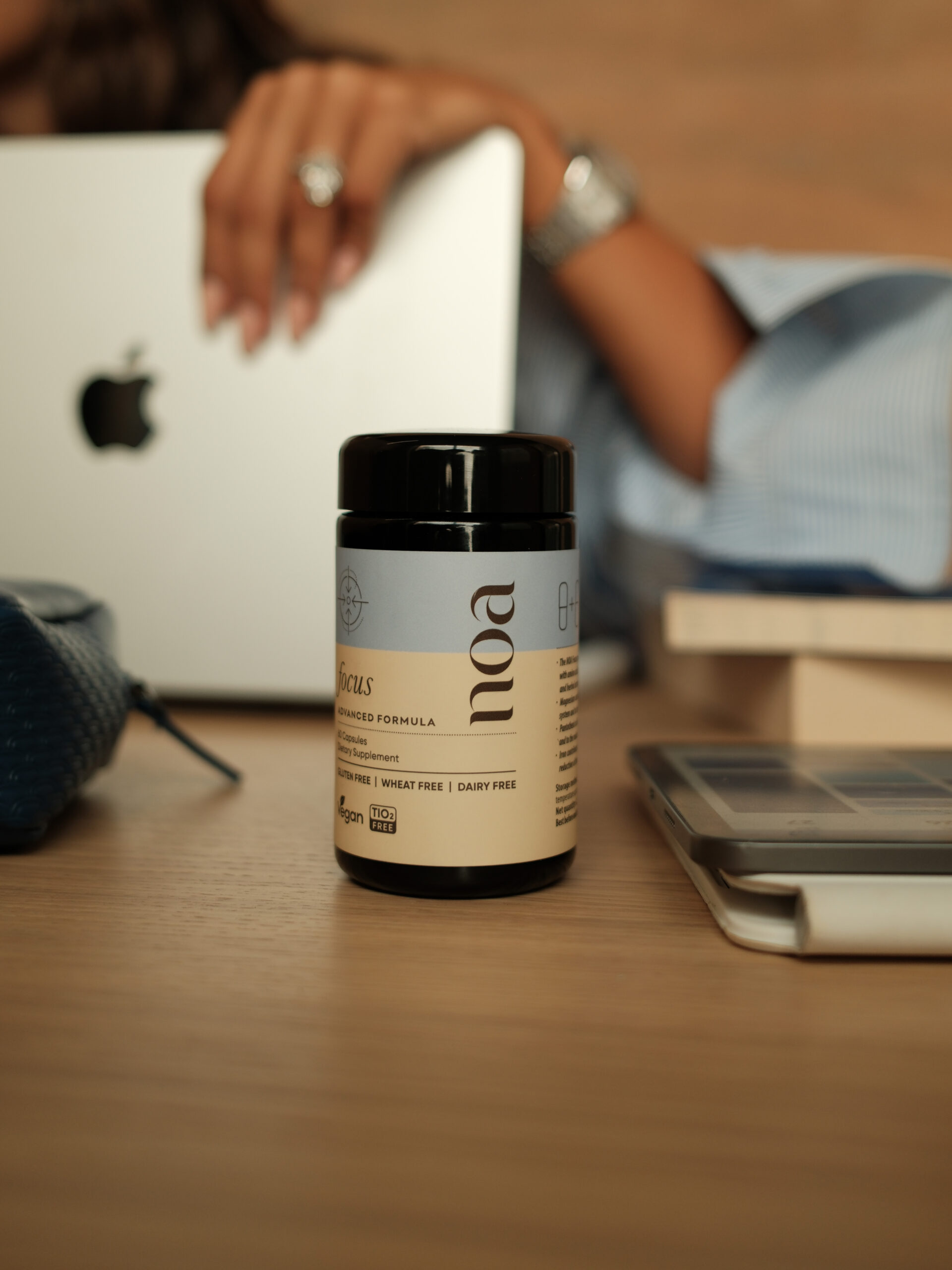
Reducing unnecessary cognitive load begins with the basics: adequate sleep, regular meals, breaks, movement and creating enough uninterrupted time for the brain to focus on one thing at a time. A supplement cannot make your decisions for you and cannot remove an overloaded schedule, but nutrition is also part of normal cognitive function, which is where NOA Focus fits into the wider picture.
NOA Focus combines amino acids, minerals, botanical ingredients and Lion’s Mane, including magnesium, pantothenic acid and iron. Magnesium contributes to normal nervous system function and the reduction of tiredness and fatigue, pantothenic acid contributes to normal mental performance, and iron contributes to normal cognitive function. The formula contains no caffeine and is designed as nutritional support for demanding days rather than as an instant stimulant.
That distinction matters. If your day contains twenty-seven unnecessary decisions, taking a supplement does not magically turn them into three. The more useful approach is to support the brain while also looking at what is constantly asking something from it. Sometimes the smartest support is nutritional, sometimes it is closing five tabs, and usually it is a combination of several sensible things rather than one dramatic solution.
Make Important Decisions Easier to Reach
One practical way to think about decision fatigue is not to obsess over whether you have a limited daily “decision budget”, but to notice where your mental effort is going. If something matters, try not to bury it underneath twenty trivial choices first. When possible, deal with more demanding decisions at a time when you feel rested and have enough space to think.
Creating defaults for repetitive choices can also help. Reduce options when the difference between them genuinely does not matter, write things down rather than forcing your working memory to carry everything at once, and give yourself permission to decide that some things are simply good enough. There is a surprising amount of freedom in no longer requiring every choice to be the best possible choice.
The Bigger Picture
Decision fatigue is an attractive phrase because it gives a name to something many of us recognise: the strange mental heaviness that can appear after a day full of deciding, organising, responding and prioritising. The research does not support an overly simple story in which every decision drains the same finite mental battery, but that does not make the experience itself irrelevant.
Our attention has limits. Mental effort matters. Context matters. Rest matters. And a day spent making hundreds of tiny choices can feel very different from a day in which the important things have enough room to breathe. So when choosing dinner suddenly feels like the most difficult question anyone has asked you all week, you may not need better decision-making skills. You may simply have made enough decisions for one day.
FAQ
What is decision fatigue?
Decision fatigue is a term used to describe the idea that repeated or prolonged decision-making can increase mental burden and make later decisions feel more effortful.
Does decision fatigue mean my brain runs out of energy for decisions?
Not literally. The idea of a fixed daily supply of decision-making power is too simplistic. Cognitive load, fatigue, stress, complexity and context all influence how demanding decisions feel.
Can reducing choices help?
Creating routines and defaults for repetitive, low-importance decisions can reduce how much active thought they require and leave more attention for decisions that genuinely matter.
Can NOA Focus support mental performance?
NOA Focus is formulated as nutritional support for cognitive function and mental performance. It contains magnesium, pantothenic acid and iron alongside amino acids, botanicals and Lion’s Mane, and it is intended to complement adequate sleep, balanced nutrition and healthy daily habits.
Is NOA Focus a stimulant?
No. NOA Focus contains no caffeine and is not positioned as an instant stimulant. It is designed as part of a consistent daily routine supporting cognitive performance.