Why Hunger Feels Different on Stressful Days
Some days, lunch happens because it is lunchtime. Other days, you have already opened the fridge three times before noon and somehow none of those visits answered the question. You ate breakfast, you are not entirely sure you are hungry, and yet by three in the afternoon something sweet feels less like a preference and more like an urgent administrative matter.
Stress can do strange things to appetite. For some people, food becomes almost impossible to think about when life gets busy. For others, the opposite happens: hunger feels louder, cravings become more specific and suddenly the kitchen seems far more interesting than it did yesterday. Neither response is particularly unusual, and neither can be reduced to a simple question of willpower.
Stress Doesn’t Affect Everyone’s Appetite the Same Way
There is no single universal stress appetite. Short-term stress can temporarily suppress appetite in some people, while prolonged or repeated stress may have a very different effect. The stress response involves a network of hormones and brain signals, including cortisol, and research suggests that ongoing stress can influence both appetite and food choice. Some people may become more drawn to highly palatable foods, while others eat less or forget to eat altogether.
That is why two people can have exactly the same chaotic Monday and react completely differently. One forgets lunch exists. The other wants lunch, a biscuit and whatever someone has hidden in the office drawer. Biology is rarely as tidy as wellness advice would like it to be.
Hunger and Appetite Are Not Quite the Same Thing
We tend to use the words interchangeably, but hunger and appetite are not exactly the same experience. Hunger is primarily a physiological signal that the body needs energy. Appetite is broader and can be influenced by sight, smell, habit, emotion, social context, reward and stress, sometimes whether or not the body urgently needs more food.
That distinction matters on stressful days. Instead of immediately asking, “Why am I hungry again?”, it can sometimes be more useful to ask what your brain is asking food to do. Maybe you need energy because lunch barely happened. Maybe you need a break. Maybe you slept badly and everything feels harder today. Or maybe you simply want something pleasurable after a day that has offered very little of it.
Why Stress Can Make Certain Foods Feel More Appealing
There is a reason stressful days do not usually create a sudden obsession with steamed broccoli. Stress interacts with brain systems involved in appetite and reward, and for some people this can make foods rich in sugar or fat feel especially appealing. But it would be far too simplistic to blame everything on one hormone.
What you ate earlier matters. How much you slept matters. What is available matters. Habit matters. And sometimes the explanation for a four o’clock sugar craving is surprisingly straightforward: breakfast was rushed, lunch barely happened and your body has finally had enough of being ignored.
The Stress, Skip, Crave Cycle
A stressful morning can easily turn into a pattern. Breakfast gets skipped, coffee carries you through the first few hours, a meeting runs over lunch and you grab something small while answering emails. By late afternoon, hunger has gone from background noise to the loudest thing in the room.
It can feel as though you suddenly lost control around food, when in reality your body may simply be responding to several hours of insufficient fuel. That is why supporting healthy eating patterns is often less about trying to suppress hunger and more about creating enough consistency that hunger does not have to become extreme before you respond to it.
Sleep Makes the Story More Complicated
Stressful periods and poor sleep are frequent travelling companions. A short night does not only leave you tired the next morning; it can also make the entire day feel harder to regulate. Food decisions may feel different, energy may fluctuate and quick, convenient options can become more attractive.
This does not mean one bad night somehow damages your metabolism. It simply reminds us that sleep, appetite, stress and energy are connected. The body does not keep stress in one box, sleep in another and metabolism somewhere completely separate. They influence one another all day long.
A Craving Is Information, Not a Moral Failure
Food and weight conversations have spent years using unnecessarily moral language: good, bad, clean, cheating, disciplined, undisciplined. None of those labels tell us very much about what is actually happening inside the body.
If stress repeatedly changes the way you eat, curiosity is usually more useful than guilt. Before immediately fighting a craving, it can help to consider whether you ate enough, whether meals have become irregular, whether you slept properly or whether you are simply looking for a break after an exhausting day. Sometimes a balanced meal will solve the problem far more effectively than trying to ignore hunger for another two hours.
Where NOA Slim Fits In
A supplement cannot remove a stressful week, and it should never replace regular meals, sleep, movement or a balanced diet. But nutritional support can be one part of a consistent wellness routine.
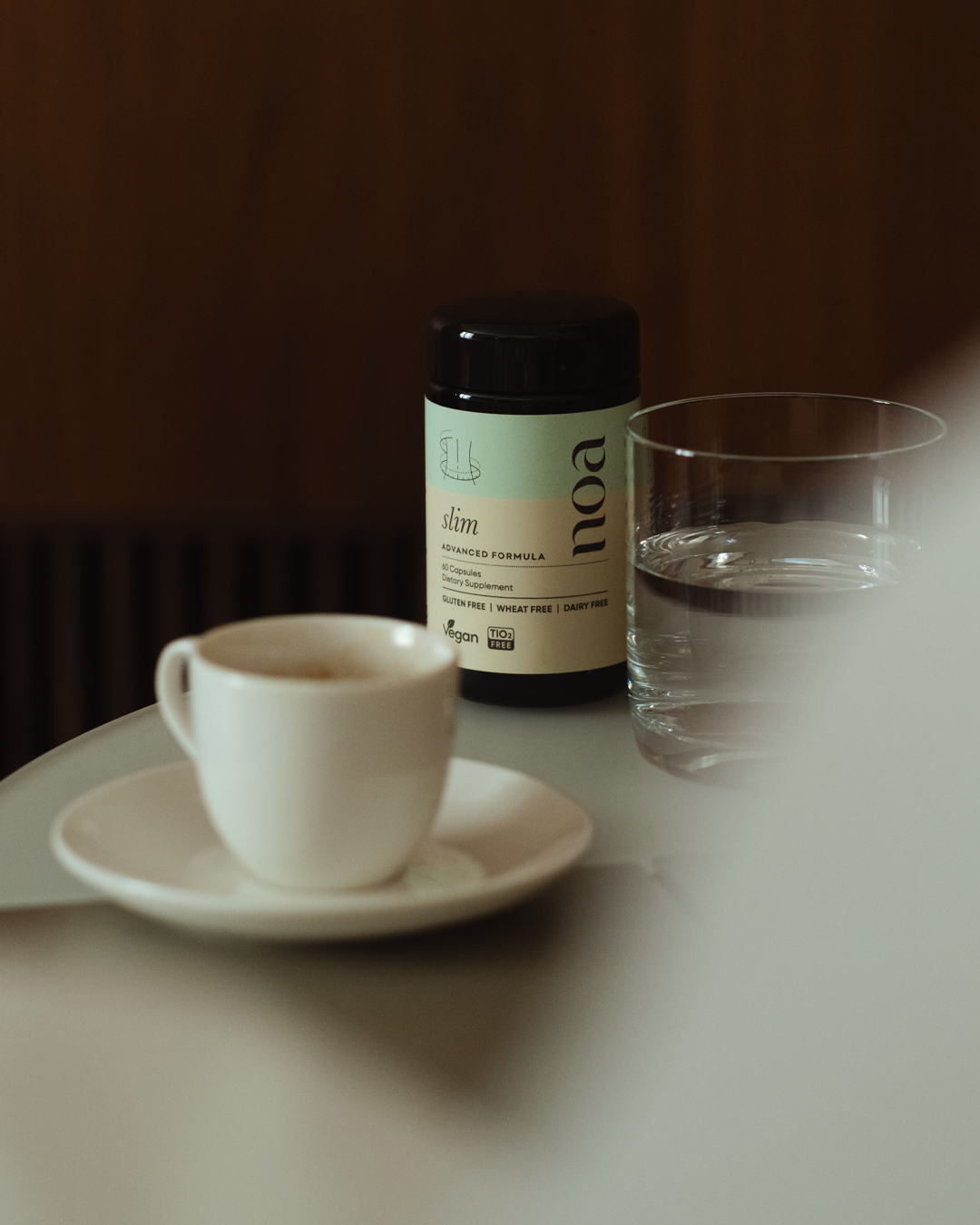
NOA Slim was formulated to support metabolism and everyday metabolic wellbeing. Its formula includes chromium, which contributes to normal macronutrient metabolism and to the maintenance of normal blood glucose levels, alongside zinc and plant-based ingredients including green tea, ginger, cinnamon, cayenne, nettle and black pepper.
That does not mean NOA Slim can cancel stress, switch off emotional eating or make every craving disappear. Its role is to support the metabolic side of your everyday routine alongside regular nutrition, movement, sleep and habits that help the body function normally. The goal is not to fight appetite, but to support the systems around it.
What Helps on Stressful Days?
Usually, the answer is less dramatic than we would like. Eating regularly when your schedule allows, building meals that actually satisfy you and keeping something practical available for chaotic days can make a meaningful difference. It also helps to notice when coffee has quietly replaced breakfast or when a busy schedule has turned lunch into an afterthought.
And if you have had an exhausting day and want dessert, you are allowed to eat dessert without turning it into a personality assessment. The most useful routine is rarely the one that looks perfect on a calm Tuesday morning. It is the one that still makes sense when Thursday goes badly.
The Bigger Picture
Stress hunger is a useful reminder that appetite does not exist in isolation. Your brain knows about your workload. Your body knows how much you slept. It knows whether you skipped lunch and whether this has been an unusually difficult week.
Sometimes what feels like a sudden lack of discipline is simply the body responding to a very different environment. So the next time hunger feels noticeably different on a stressful day, perhaps the first question should not be, “How do I stop this?” Try asking, “What changed today?” The answer may tell you far more.
FAQ
Can stress make you feel hungrier?
Yes, for some people. Longer-lasting stress can influence appetite and food preferences through both physiological and behavioural pathways. Other people experience reduced appetite under stress, so individual responses vary.
Why do I crave sweet or high-fat foods when I am stressed?
Stress can interact with brain reward systems and appetite signals, which may make highly palatable foods feel more appealing. Sleep, meal timing and eating habits can also play a role.
Can skipping meals make cravings worse later?
Going long periods without adequate food can naturally increase hunger later in the day. On stressful days, irregular meal patterns can make hunger feel much more intense.
Does poor sleep affect appetite?
It can. Sleep disruption can influence appetite-related signalling, food preferences and everyday energy regulation.
Can NOA Slim help support metabolism?
NOA Slim is designed to support normal metabolic processes as part of a balanced diet and healthy lifestyle. It is intended to complement regular nutrition, movement and rest rather than replace them.